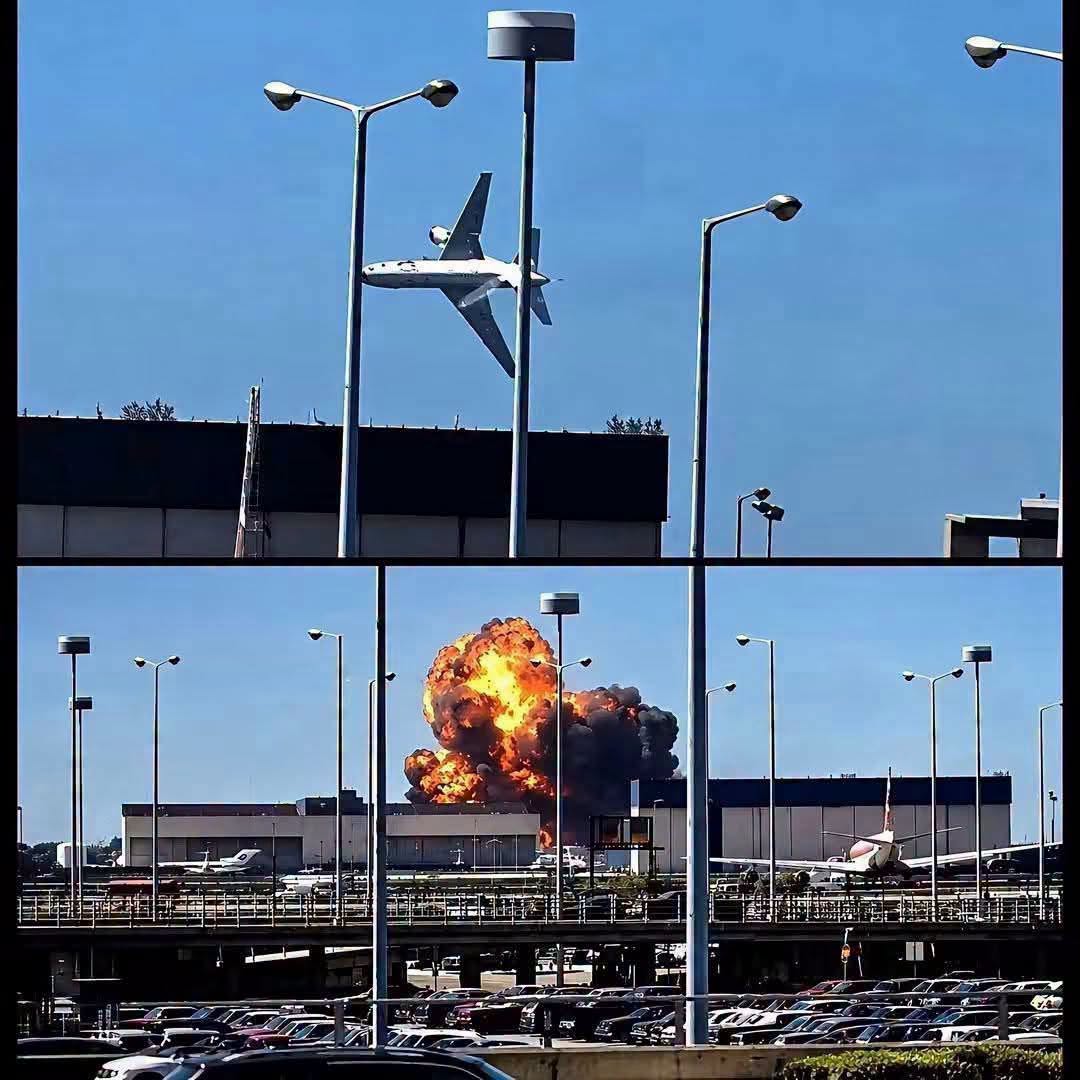
American Airlines Flight 191: The Takeoff from Chicago….
American Airlines Flight 191: The Takeoff from Chicago That Turned Into a Deadly Aviation Disaster
On May 25, 1979, a routine takeoff from Chicago’s O’Hare International Airport became one of the deadliest aviation disasters in American history. American Airlines Flight 191 was airborne for just 31 seconds before tragedy struck, claiming 273 lives.
It was a clear Friday afternoon when American Airlines Flight 191, a McDonnell Douglas DC-10-10, prepared to depart Chicago for Los Angeles, California.
There were 258 passengers and 13 crew members aboard the aircraft. Everything initially appeared normal as the plane taxied toward Runway 32R and received clearance for takeoff.
But as the aircraft accelerated down the runway, something catastrophic happened.
During takeoff rotation, the left engine, along with its supporting pylon assembly and a section of the wing’s leading edge, suddenly separated from the aircraft and fell onto the runway.
Despite the damage, the DC-10 managed to lift off.
The pilots believed they were dealing with an engine failure. However, they were unaware that the engine and pylon had separated and that critical aircraft systems had also been damaged.
The separation severed hydraulic lines, causing the leading-edge slats on the left wing to retract unexpectedly. At the same time, important warning systems, including the stall-warning system, became inoperative.
The aircraft climbed to approximately 325 feet before beginning to roll sharply to the left.
The pilots attempted to maintain control, but the aircraft continued rolling until its wings passed the vertical position.
Just 31 seconds after leaving the runway, Flight 191 crashed into an open field near a trailer park in Des Plaines, Illinois.
The aircraft was destroyed in the impact and subsequent fire. All 271 people aboard were killed, along with two people on the ground. Two other people on the ground were injured.
What caused the tragedy?
Following an extensive investigation, the National Transportation Safety Board (NTSB) determined that improper maintenance procedures had caused structural damage to the engine pylon during an earlier maintenance operation.
The engine and pylon had been removed and reinstalled together using a forklift, rather than following the recommended procedure of removing them separately.
The resulting damage weakened the pylon structure. Eventually, it failed during the critical takeoff phase.
The investigation also identified shortcomings in aircraft design, maintenance practices, and regulatory oversight.
A tragedy that changed aviation safety
The disaster exposed serious weaknesses in aircraft maintenance procedures and safety oversight. It led to recommendations aimed at improving maintenance practices, inspection procedures, and aviation safety standards.
American Airlines Flight 191 remains a sobering reminder of how a seemingly small maintenance error can have devastating consequences.
Behind the statistics were 273 lives, families, and futures lost in a matter of seconds.
A routine takeoff became a tragedy that the aviation industry would never forget.